01 / The name

A brook.
A name.

About elder trees, old writings and the search for our origin.

One name, three parts

VanOrigin
HolderElder tree
BekeBrook

From a place by a brook
where elder trees grow.

Meaning according to the original research
This is a translation. Roland Van Holderbeke wrote the original in Dutch; where the two differ, the Dutch text is authoritative. Read the Dutch original.

Original research by Roland Van Holderbeke · Pagina1.htm. Conjectures about kinship and origin remain hypotheses of the original author.

About the sources

01 / Meaning

Meaning of the name

HOLDERBEKE : is the name of a hamlet in Sint-Martens-Lierde (now Lierde), in the province of East Flanders, lying some three km outside Brakel, in the direction of Geraardsbergen, along the N8.

Meaning of the name Van Holderbeke :

The name consists of three parts:

  1. Holder : comes from the Old Dutch/German name for the elder tree or elder bush (Holdre, Holler, Holder, holre).
  2. Beke : the name says it all, namely a brook (beek).
  3. Van : of, from …

So Van Holderbeke means: he (or she) who comes from a place by a brook where elder trees or elder bushes grow. We still have a Hollebeek between Schorisse and Nukerke (see further below). There is still a brook in the hamlet of Holderbeke, now called the Laarebeek. In 2003, however, I found no elder trees or bushes there any more.

There is a German synonym : Holderbach, von Holderbach (still found in Austria today), probably arising from a translation of our name into German in the period of Maximiliaan van Oostenrijk (Maximilian of Austria), by van Holderbeke’s or Van Holderbeke’s who settled there. Holder is still the name for the elderberry in Austria.

02 / The earliest traces

Origin of the name

The oldest writings in which a reference to the name Van Holderbeke occurs date from:

  1. 1275

    An old text refers to a place lying between Nukerke and Schorisse (is that the “Goed ter Holderbeke, the Holderbeke estate ?). Even now a small watercourse called the Hollebeek runs through Schorisse.

    Extract : «Enoud de le Holrebeque …… encosté le voie de Renais à le Holrebeke ……» (Enoud de le Holrebeque …… alongside the road from Renais to le Holrebeke ……). Ref. VR 1950 L. Verriest Le Polytyque Illustré « veil Rentier » de Messire Jehan de Pawele – Audenarde (1275) Bibliothèque Nationale de France à Paris. Written in old Tournai dialect.


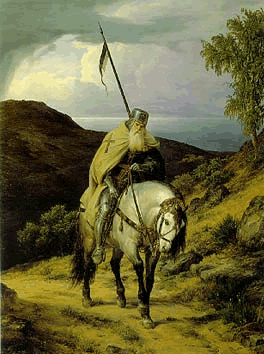
    A lonely crusader, from the retinue of the Count of Flanders, Gwijde van Dampierre (Guy of Dampierre), on the way back from the failed Eighth Crusade: that is how Enoud must have felt on his journey back to his hearth.

    The lonely crusader on the journey back home.

  2. 1360

    Tells us of the existence of a Gérard de Holrebecque
    Ref. : Inventaire des archives des chambres des comptes de Bruxelles.

  3. 1396

    The “Buitenpoortersboek van Geraerdsbergen” (the register of outburghers, citizens living outside the town, of Geraardsbergen) (LVA VI, 1- 109) of 1396 records the following names:
    Gillis fs Pieter van der Holderbeken (paid 8 s)
    Jan van der Holderbeken (paid 8 s)
    Pieter van der Holderbeken et + ux. Trude (paid 9 s)
    All living in Sente Martins Lierde, Holderbeke (Ref D37 – J. De Brouwer: Blz. 37 – 61 Sente Martins Lierde 22v°). In that book the evolution of the spelling of the name Holderbeke can be followed well. In 1396 it is already written Holderbeke; shortly afterwards the place was called “Ter Hollebeke”, and shortly after that Holderbeke in Sente Martins Lierde again. The latter became Sint Martens Lierde, now Lierde (since the merger of the municipalities).
    The hamlet «Holderbeke» still exists in Lierde, just outside Brakel, along the N8 towards Geraardsbergen.

  4. 1571

    In Schorisse there was a “Goed Ter Holderbeke”; the name is mentioned in a deed of 1571, but it existed much earlier (see Enoud de le Holrebeque of 1275).
    There is still a small watercourse called the Hollebeek between Schorisse and Nukerke.
    Of the Goed ter Holderbeke no trace at all can be found on the spot any more, no ruins, no markers; but the place name, or rather a small wood, “Ter Beke” still exists, so a possible link or hypothesis of origin after all.

    The surname Holderbeke still exists in Lierde today (5 or 6 families)

03 / A missing link

When in Waarschoot ?

When the name Van Holderbeke first appears in Waarschoot I have not been able to establish; nor have I been able to find the connection between the (Van) Holderbeke of Sint-Martens-Lierde from 1396 or earlier and those of Waarschoot (not yet!?). So there is a gap of about a hundred and fifty years. There are only a few possible trails to follow and investigate in this respect:

Trail 1 · hypothesis from the source

Nieuwenhove & Arisdonk

1. Straddling the border of three municipalities, Lovendegem, Sleidinge and Waarschoot, lay the “Heerlijkheid Nieuwenhove” (the heerlijkheid, or seigniory, of Nieuwenhove), which was a fief of the Oudburg (the castellany) of Ghent, and so of the Count of Flanders. It had its own (lower) jurisdiction, it had a baljuw (bailiff) and 7 schepenen (aldermen). The oldest known holder of this “heerlijkheid” is found in a deed of 1331 (ARA-RR, rolrekening anno 1331). He is a Jehan van Brakel (Jehans de Bracle). Given the location of the hamlet of Holderbeke in Lierde, barely 3 km outside Brakel, it is quite possible that people from that Holderbeke came along with their lord to work in the “Heerlijkheid Nieuwenhove”, so that they were given the name Van … Holderbeke (coming from Holderbeke). A nearby street, Arisdonk, was moreover one of the two main places where the Van Holderbeke family lived in the 17th century.
Trail 2 · hypothesis from the source

Goed ten Brakel & Weststraat

2. In Waarschoot itself, however, there was a “Goed ten Brakel” (the Brakel estate). Here we are looking at one of the oldest colonies or settlements on the edge of the Westmoer in Waarschoot. Its first owner, likewise mentioned in 1331, is called Wouter van Brakel (RAG – SP Rol 1010 bis – circa 1331). It was customary at that time to name an estate after its first owner or after his origin. The same supposition as above applies to the name, or the appearance, of the Van Holderbeke in Waarschoot. This Wouter van Brakel was related to the aforementioned Jehan van Brakel. Here we find the other main place where the Van Holderbeke families lived in the 17th century; the street is called : Weststraat.
But already by the end of the 17th century the name is spread over the whole territory of the Ambacht Waarschoot (an ambacht was a rural district with its own administration) and the surrounding parishes.

The supposition that people from Holderbeke, or from the Hof ter Holderbeke, came along with the Lords of Brakel can therefore certainly be accepted. In that case we must place the arrival of the first Van Holderbeke’s in Waarschoot in the period around 1330.

The land of Geraardsbergen- Brakel, like Waarschoot, fell under the direct authority of the Oudburg of Ghent, and so of the Count of Flanders, who from the 13th century granted feudal rights to his loyal vassals and servants for the clearing and use of the land in Waarschoot.

So I assume that we are heading in the right direction in supposing that our distant ancestors came from the hamlet of Holderbeke in Lierde, and that the people who came from there with the Lords of Brakel were called by that name, from which the name Van Holderbeke then sprang. It therefore remains for me to provide the “proof” and to find the missing links between the middle to end of the thirteenth century and the middle to end of the sixteenth century, the time from which the first deeds in Waarschoot exist. The name Van Holderbeke, in this spelling, already appears in Waarschoot in the first written deeds around 1560.

04 / The same name, other letters

Spelling of the name Van Holderbeke

The spelling of our name Van Holderbeke does not, in principle, vary much, and only small differences can be found.
Van Holderbeke occurs in the following forms: Van Holderbeke itself, the most common spelling and also the base name; then Vanholderbeke (in one word, still in existence today); and then, depending on the period of the occupation of Flanders by foreign powers, we also find the name in the following forms: Van Olderbeke, Olderbeke, Van Holderbeeke, Van Holderbeecke, Van Holderbecke, Van Holderbeeck, Holderbeek, Holderbeke, Van Holderbecque etc…; the base name, however, can always be clearly recognised.
These variants are mostly the result of an official unfamiliar with the language (local dialect) who wrote the name “phonetically”, by ear and according to his own usage (Austrian, French, Spanish, Dutch rule). I once noticed that one and the same Van Holderbeke appears in the registers in three different forms. It also happened that the child’s name was written wrongly in one and the same deed and differed from the spelling of the father’s name. People were not always very particular in those days.
At present the following four variants exist: Van Holderbeke, Holderbeke, Vanholderbeke and van Holderbeke.

05 / A historical reference

Arms and Motto

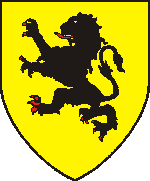
The knight “Enoud de le Holrebeque» mentioned above had no coat of arms of his own, but bore as his arms those of his liege lord, the Count of Flanders ( Ref. : blazoen der Wapens van Vlaanderen, II, N° 21809).

Coat of arms of the Count of Flanders, Gwijde van Dampierre

He did, however, have a motto of his own, in old Tournai dialect:

Which means roughly:

« Zonder   Vrees   noch   Erbarmen » (Without Fear or Mercy)

References: The meaning of the name Van Holderbeke was confirmed by two Belgian genealogists and historians (Mr. Y. De Baets and Mr. Louagie) and by the archivist of the Bibliothèque National de France (Francois Mitterand).

Most frequent references throughout the collection :

  1. ARA : Algemene Rijksarchieven (General State Archives) in Brussels
  2. RAG : Rijksarchief (State Archives) in Ghent
  3. RAB : Rijksarchief (State Archives) in Beveren
  4. SAG : Stadsarchief (City Archives) in Ghent
  5. VVF : Vlaamse Vereniging voor Familiekunde (Flemish Association for Family History), Centre in Melle
  6. AWA : Archives of the Municipality of Waarschoot
  7. APW : Archives of the Parish of Sint Ghislenus in Waarschoot
  8. IGN/NGI : geographical maps of Belgium – extracts
  9. BNF : Bibliothèque Nationale de France – François Mitterand - Paris
  10. CGF : Centr Généalogique de France - Paris

Further in the story

The name
takes on faces.

Follow the family line